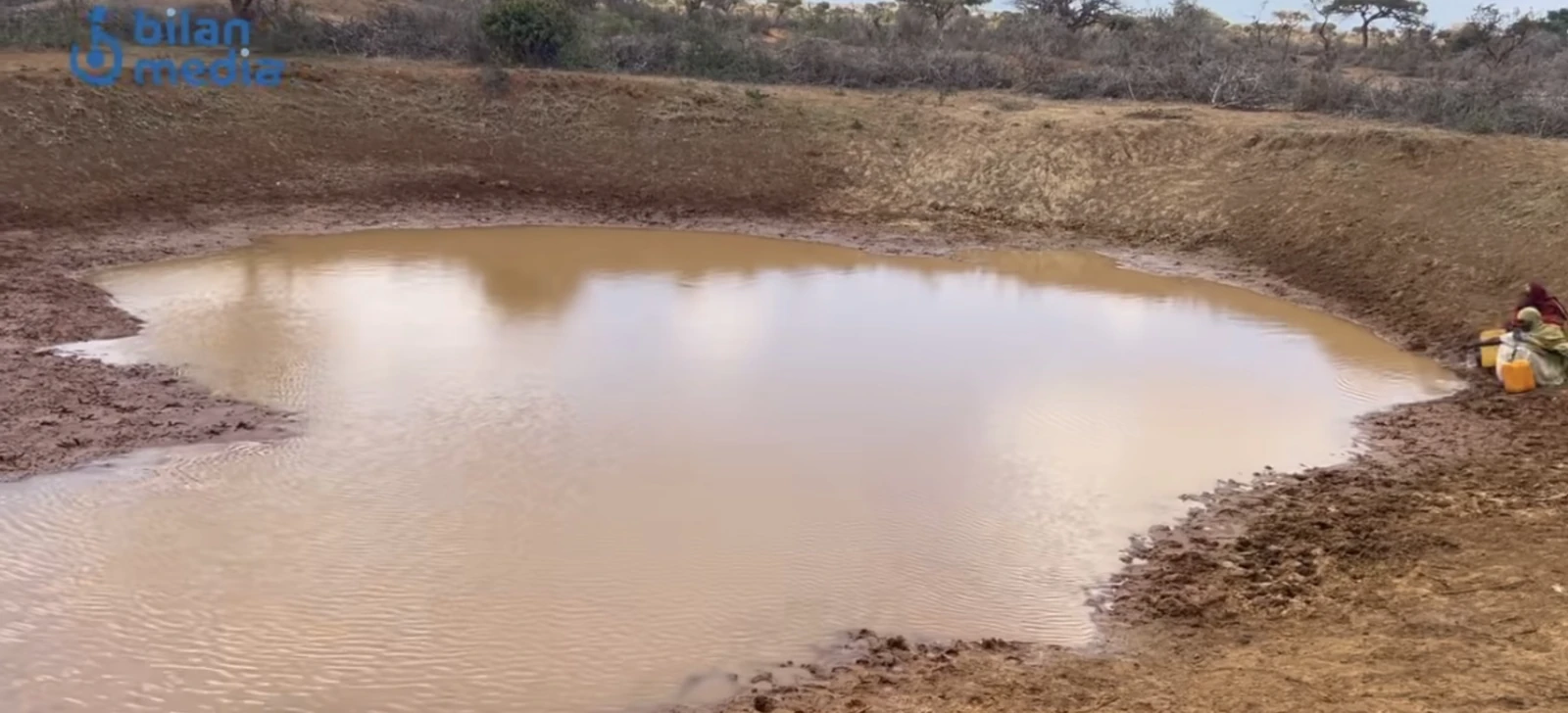

Under the scorching sun of western Kismayo, 35-year-old Cadeey Cali, who is pregnant, begins her first journey of the day to fetch water. She carries a 20-litre plastic container, making two trips daily to secure enough water for her children. During her journey, there is no tree or shade where she can rest.
Out in the open, without any protective cover, she fetches water not only for herself but also for other women living in Bahnano village and nearby areas. The villagers, their livestock, and other local animals all rely on the same water source.
I carry the water myself; no one else can do it for me. I have very little hope; the ten litres I manage to carry barely make a difference — I often spill some along the way.
These waters are not clean or safe to drink, but we have no alternative — so we drink it anyway.
A crisis that crosses villages
The water shortage affects not only the women of Bahnano but also people living in nearby villages like Shinbireey.
When I ran out of water at Hanoogane, I went to a man who had some. I told him, "My children are thirsty, please give me water." He refused, but someone else helped me. In the morning, I left my children at home and returned in the afternoon — I had to search three times to get water.
During the dry season, as the river continues to shrink, the nomadic families of Bahnano travel long distances to find water. These journeys are dangerous.
When nomadic people go to fetch water, their carts are at risk from landmines along the paths.
A village without a well
We asked the village chief of Bahnano whether there have been efforts to provide access to clean drinking water. Bahnano, which has hosted displaced families for the past four years — with 280 households living there alongside three nearby villages — does not have a well.
Cumar Ismaaciil Nuur, Coordinator for the Lower Jubba region at the Ministry of Energy and Water Resources in Jubaland, explained why these villages have been overlooked.
The land in the villages you visited in western Kismayo is difficult; extensive surveys have been conducted, and it is very challenging to find a source of clean water. It is also hard for nomadic people to relocate from their land.
Efforts by the people of Bahnano to dig a well have failed because rocks have blocked the site. The well would need to be demolished and rebuilt to provide water. The community has requested assistance to cover the costs.